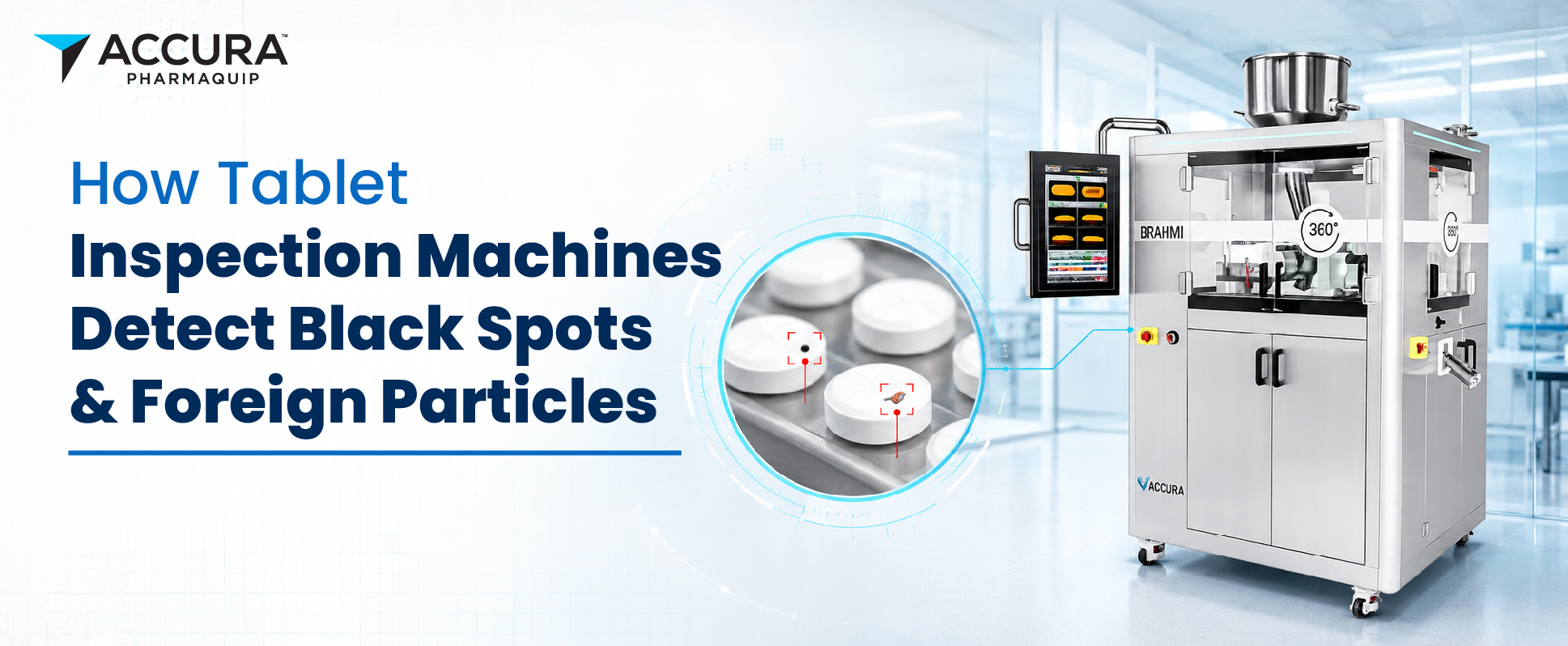
A tiny black spot on a tablet may appear insignificant, but in pharmaceutical manufacturing, even a small visible anomaly can trigger investigation, rejection or additional quality-control action.
Tablets need to meet defined visual and physical quality requirements before they reach packaging. Black spots, stains, dirt, discoloration and visible foreign particles can indicate a quality issue that needs to be identified and investigated.
As pharmaceutical production becomes faster, inspecting every product manually becomes increasingly challenging. Automated vision inspection offers manufacturers a way to examine tablets consistently while keeping pace with production.
But how exactly does a tablet inspection machine detect a black spot or foreign particle?
The answer involves much more than simply placing a camera above a production line. Product presentation, lighting, image capture, image processing and automated rejection all work together to create an effective inspection process.
Understanding Black Spots and Foreign Particles
Before looking at the technology, it is important to understand what the inspection system is actually looking for.
What Are Black Spots on Tablets?
Black spots are visible dark areas or abnormalities that may appear:
- On the tablet surface
- Along tablet edges
- Around coating irregularities
- As isolated dark areas
- As stains or discoloration
The cause of a black spot can vary, so identifying one does not by itself determine the nature or composition of the defect. Instead, it serves as a visual indication that the product may not meet the defined inspection criteria.
What Are Foreign Particles?
Foreign particles refer to unwanted visible material that may appear on or with a tablet during manufacturing.
Depending on the manufacturing environment, these may include:
- Dust or dirt
- Fibres
- Dark particles
- Unwanted particulate matter
- Other visible contaminants
An important distinction is that vision inspection detects visible optical anomalies; it does not determine the chemical composition of a particle. Chemical identification, microbiological testing or other analytical requirements require appropriate laboratory techniques.
How Automated Vision Inspection Detects Black Spots
A modern tablet inspection machine essentially combines several stages:
Tablet Handling → Controlled Lighting → Image Capture → Image Processing → Defect Classification → Automatic Rejection
Each stage contributes to the accuracy and consistency of the inspection.
Step 1: Controlled Tablet Presentation
Positioning the Tablet for Inspection
Before a camera can identify a defect, the tablet needs to be presented consistently.
The inspection system must:
- Separate products adequately
- Maintain controlled product movement
- Present tablets consistently
- Expose relevant surfaces to the cameras
Consistent product presentation creates repeatable imaging conditions. If tablets are moving unpredictably or overlapping, even a high-quality camera may not capture useful images.
For example, Accura’s BRAHMI uses a vacuum-based mechanism and is designed for automated inspection of tablets, capsules and softgels.
The objective is simple: ensure that each product reaches the inspection zone in a predictable position so that the vision system can evaluate it effectively.
Step 2: High-Intensity Lighting
Why Lighting Is Critical for Black Spot Detection
A common misconception is that inspection quality depends primarily on camera resolution.
In reality, lighting is just as important.
Controlled illumination helps create contrast between the tablet and potential defects. This allows the inspection system to distinguish visual differences involving:
- Tablet surface
- Dark spots
- Stains
- Edges
- Coating variations
- Other visible anomalies
Accura’s published technical material describes BRAHMI’s vision system as incorporating a high-intensity light source alongside six industrial vision cameras and independent image-processing controllers.
This illustrates an important principle: effective vision inspection depends on the interaction between lighting, cameras, product presentation and image-processing software, rather than any single component.
Step 3: High-Resolution Image Capture
How Cameras Capture Tablet Images
Once the tablet is correctly positioned and illuminated, industrial cameras capture images as it passes through the inspection zone.
Multiple cameras can be used to:
- View different surfaces and angles
- Reduce potential blind spots
- Capture edges and curved areas
- Provide broader inspection coverage
- Support high-speed inspection
Accura’s BRAHMI system uses six industrial vision cameras, independent image-processing controllers and 360° product inspection.
A simplified representation is:
The images captured from these different views provide the software with more information than a single camera angle could typically provide.
Step 4: Image Processing Detects the Anomaly
How Software Identifies Black Spots
The captured images are evaluated by inspection software against predefined product criteria.
The system can identify visual differences involving factors such as:
- Colour
- Shape
- Size
- Sports
- Stains
- Edge defects
- Other programmed defect conditions
A black spot may appear as a significant contrast or deviation from the expected appearance of the tablet surface.
The system then evaluates whether that visual difference falls within the acceptable criteria or should be classified as a defect.
It is important not to assume that every modern inspection system necessarily relies on AI. High-speed machine vision and image-processing technologies can perform sophisticated inspection without requiring unsupported claims about artificial intelligence.
How Tablet Inspection Machines Detect Foreign Particles
Contrast-Based Detection
Foreign particle detection follows a similar visual principle.
A visible particle may differ from the surrounding tablet in:
- Colour
- Brightness
- Shape
- Texture
- Location
These differences can create an optical contrast that the vision system can identify as a potential defect.
However, the particle must be visually detectable for conventional vision inspection to identify it. A material hidden inside a tablet or one that does not create a detectable visual difference may require a different analytical method.
Surface and Edge Inspection
Inspecting both surfaces and edges is particularly important.
A dark spot or particle may not be visible from a single viewing angle. It could be located near an edge, on a curved surface or on another area that a fixed camera cannot see clearly.
Why 360° Tablet Inspection Improves Defect Detection
A tablet is a three-dimensional product. A single camera angle may not provide sufficient visibility of every relevant area.
These may include:
- Top surface
- Bottom surface
- Side walls
- Edges
- Curved surfaces
Multiple camera views can therefore provide broader inspection coverage.
Accura describes BRAHMI as providing 360° inspection, supported by a six-camera vision configuration.
Single-View vs. 360° Inspection
Single Camera
Potential blind spots → ⚠️
Top + bottom + edges + sides → ✓
The purpose of multi-camera inspection is not simply to increase the number of cameras. It is to provide the inspection system with a more complete view of the product and reduce areas that could otherwise remain difficult to inspect.
From Detection to Automatic Rejection
Finding a black spot is only one part of the inspection process. The defective product must also be separated from acceptable products.
The process can be summarized as:
1. Tablet enters inspection zone
↓
2. Cameras capture images
↓
3. Software analyses images
↓
4. Potential defect is identified
↓
5. Tablet is classified as reject
↓
6. Rejection mechanism separates it from accepted product
Accura’s NETRA VS6 is designed to automatically sort rejected products, reducing the need for manual sorting after inspection.
This integration between detection and rejection is particularly important in high-speed production environments where manually removing individual defective products would be impractical.
Beyond Black Spots: Other Defects Detected by Vision Inspection
Black spots are only one category of visual defect that automated tablet inspection systems can identify.
Surface Defects
Depending on system configuration, these can include:
- Black spots
- Stains
- Dirt
- Rough or patchy surfaces
- Discoloration
Physical Defects
Inspection can also be configured to identify:
- Cracks
- Chipping
- Broken edges
- Dents
- Shape abnormalities
Identification and Marking Defects
Some systems can also inspect features such as:
- Embossing
- Debossing
- Printing irregularities
Accura lists these types of defects among the inspection capabilities of NETRA VS6.
What Automated Vision Inspection Can—and Cannot—Detect
Vision inspection is highly useful for identifying defects that create a visible optical difference.
It is well suited to detecting:
- Visible particles
- Dark spots
- Surface contamination
- Surface contamination
- Colour abnormalities
- Shape anomalies
- Other visible defects
However, it is not a substitute for chemical analysis, microbiological testing or laboratory identification.
For example, a vision system may detect a visible dark particle on a tablet, but it cannot determine whether that particle is a particular chemical substance simply from its appearance.
Therefore, automated vision inspection should be viewed as an important visual quality-control layer, working alongside the broader pharmaceutical quality system.
Why Automate Black Spot and Foreign Particle Inspection?
Manual inspection can become increasingly difficult as production speeds rise.
| Factor | Manual Inspection | Automated Vision Inspection |
|---|---|---|
| Inspection consistency | Operator dependent | Programmed criteria |
| Production speed | Limited by operators | High-speed |
| Fatigue | Possible | No visual fatigue |
| Multiple viewing angles | Difficult | Multi-camera possible |
| Automatic rejection | Limited | Yes |
| Inspection data | Limited | Can be digitally recorded |
| Scalability | Challenging at high throughput | Better suited to automated lines |
Automation does not eliminate the need for qualified personnel, validated procedures or quality oversight. Instead, it provides a consistent and scalable method for handling repetitive visual inspection tasks.
Benefits of Automated Black Spot Detection
For pharmaceutical manufacturers, automated visual inspection can offer several operational benefits:
- Potential for 100% inspection, depending on system configuration
- Consistent inspection criteria
- Faster defect identification
- Automatic rejection
- Reduced manual handling
- Better production-line integration
- Improved process monitoring
- Support for traceable inspection records
Accura’s BRAHMI is described as fully automated, capable of 360° inspection and equipped with high-speed image-processing controllers. Its published capacity is up to 150,000 pills per hour, subject to product size and customisation.
Automated Tablet Inspection Solutions by Accura Pharmaquip
We at Accura Pharmaquip offer automated inspection systems for pharmaceutical manufacturing, with a focus on tablet and capsule inspection using vision technology.
Its solutions are designed to identify visual defects such as surface flaws, colour deviations and contamination.
NETRA VS6
NETRA VS6 is positioned around:
- Automated tablet and capsule inspection
- Black spot detection
- Dirt detection
- Surface and edge inspection
- Automatic rejection
- High-speed production
Accura specifically lists black spots on surfaces or edges among the detectable defects.
BRAHMI
BRAHMI is an automated inspection platform featuring:
- Six industrial vision cameras
- 360° inspection
- High-speed image processing
- Tablet, hard-gel and soft-gel inspection
- Automated operation
- Capacity of up to 150,000 pills per hour, subject to product size and customisation
The appropriate system ultimately depends on the product, production speed, inspection requirements and desired level of automation.
7 Factors to Consider Before Buying a Tablet Inspection Machine
If black spot and foreign particle detection is a key requirement, manufacturers should evaluate more than just camera specifications.
Consider:
- 1. Camera resolution – Can the system capture the size and type of defects you need to identify?
- 2. Number and positioning of cameras – Does the configuration provide sufficient inspection coverage?
- 3. Lighting configuration – Can the lighting create adequate contrast for the target defects?
- 4. Inspection coverage – Are surfaces, edges and other relevant areas being inspected?
- 5. Defect sensitivity and tolerance settings – Can inspection parameters be configured according to product requirements?
- 6. False-rejection performance – Can the system distinguish genuine defects from acceptable product variation?
- 7. Production speed and integration – Can the inspection system operate at the required production rate?
Manufacturers should also consider changeover time, cleaning and maintenance, data management, batch reporting, validation requirements, product range and reject-system design.
Automated Vision Inspection Makes Black Spot Detection Faster and More Consistent
Black spots and visible foreign particles are among the visual defects pharmaceutical manufacturers need to control before tablets reach packaging.
By combining controlled lighting, industrial cameras, image processing and automated rejection, modern tablet inspection machines can identify visible anomalies at production speed while applying consistent inspection criteria.
The technology is not a replacement for every form of pharmaceutical testing. Instead, it provides an important visual inspection layer that can complement broader quality-control processes.
Accura Pharmaquip’s automated inspection solutions are designed to inspect tablets and capsules for a range of visual defects, including black spots, dirt, stains, shape abnormalities and other surface defects. With multi-camera and 360° inspection capabilities available on systems such as BRAHMI and NETRA VS6, manufacturers can move towards more automated and consistent visual quality inspection.
FAQs
Can a tablet inspection machine detect black spots?
Yes. Automated vision inspection systems can be configured to identify visible black spots and other surface anomalies.
How does a vision system detect black spots on tablets?
It uses controlled illumination, industrial cameras and image-processing software to identify visual deviations from defined product criteria.
Can tablet inspection machines detect foreign particles?
They can detect visible foreign particles and contamination that create an identifiable optical difference in the captured image.
Can inspection machines detect particles inside a tablet?
Not necessarily. Conventional visual inspection primarily identifies visible external defects. Internal analysis may require other techniques.
Why are multiple cameras used in tablet inspection?
Multiple cameras provide different viewing angles and help inspect more of the tablet’s surfaces and edges.
What other defects can a tablet inspection machine detect?
Depending on the system and inspection parameters, defects can include cracks, chips, broken edges, dirt, stains, colour variation, embossing or printing problems and other visual abnormalities.
What is 360° tablet inspection?
360° inspection refers to inspecting a tablet from multiple views to achieve broader coverage of its surfaces and edges.
Does automated inspection eliminate manual quality control?
No. Automated inspection is a quality-control tool that should operate within the manufacturer’s validated procedures and overall quality system.