Whereas in pharmaceutical production, the label plays a bigger role than merely containing printed information. The label contains vital information including the product name, batch number, manufacturing date, expiry date, dose information and other vital information needed to handle the product safely and properly.
However, one vital question that all pharmaceutical manufacturers need to ask themselves is: How effective is your inspection of the label?
A small mistake in printing, omission of a letter, wrong batch number, and even poor positioning of the label poses a great challenge in terms of quality and compliance. With increasing production speed, it becomes harder to spot any problems with the labels using only manual inspection. Automated label inspection helps a lot in such situations.
Here at Accura Pharmaquip, we understand the significance of proper label inspection in pharmaceutical packaging. We explain here why label inspection is important, how label inspection process works and ways to improve your inspection process.
Why Is Label Inspection Important?
Pharmaceutical labels contain information that helps identify and track products throughout their lifecycle. If this information is incorrect or unreadable, it can affect product traceability and create serious quality concerns.
Label inspection helps manufacturers identify issues such as:
- Missing labels
- Incorrect labels
- Misaligned labels
- Poor-quality printing
- Missing or incorrect batch numbers
- Incorrect expiry or manufacturing dates
- Unreadable characters
- Damaged or incomplete barcodes
- Incorrect product information
Detecting these problems before products leave the manufacturing facility helps reduce the risk of packaging errors and supports consistent quality control.
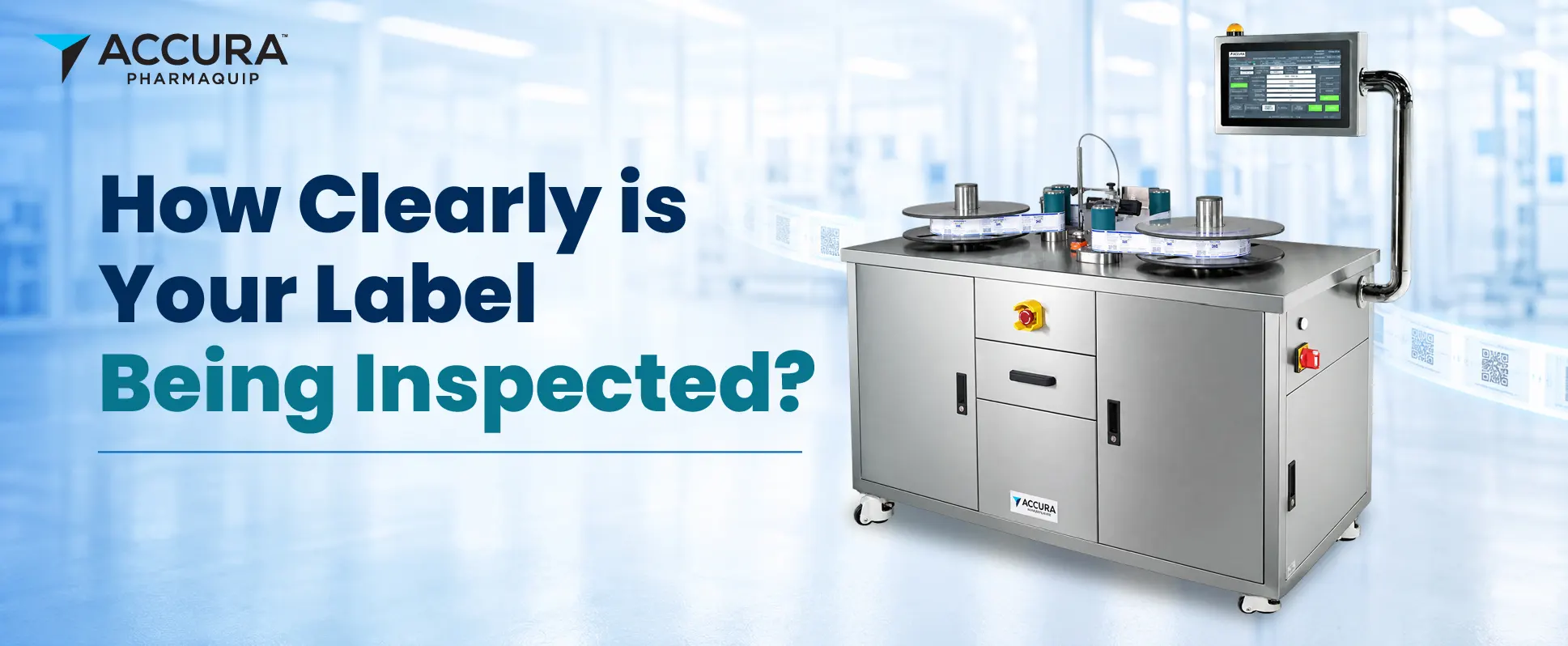
How Clearly Is Your Label Being Inspected?
There are many factors influencing the ability to conduct an accurate label inspection; these include the type of inspection being carried out, the resolution of the camera being used, lighting, software, rate of product, and parameters of quality specified by the manufacturer.
While manual inspection may be necessary in some cases, it is subject to human elements like fatigue, repetitiveness, lighting, and rate of production.
Label inspection using automated vision based inspection involves capturing images of the label using cameras and analyzing the information obtained by the software.
The system will then detect products that do not conform to the set standards.
How Does Automated Label Inspection Work?
An automated label inspection system generally involves several stages.
1. Product Positioning
Products are accurately positioned as they enter the inspection area. Consistent positioning allows the camera to capture the label clearly.
2. Image Capture
A high-resolution camera captures images of the label while the product moves through the inspection station.
Appropriate lighting is particularly important because it helps create clear images and improves the system’s ability to identify printing and labeling defects.
3. Image Analysis
Inspection software analyzes the captured image according to predefined quality parameters.
Depending on the application, the system may check text, characters, barcodes, label presence, position, or other visual characteristics.
4. Comparison With Reference Data
The captured information can be compared with approved reference information or predefined inspection criteria.
If the system detects a mismatch or defect, the product can be flagged for rejection or further inspection.
5. Rejection of Defective Products
Products that fail the inspection criteria can be automatically separated from accepted products, depending on the equipment configuration.
This helps prevent incorrectly labeled or defective products from progressing further through the packaging process.
What Can a Label Inspection System Check?
A suitable inspection system can be configured according to the manufacturer’s specific requirements.
Common inspection parameters may include:
- Label Presence: The system can determine whether the required label is present on the product.
- Label Position: Incorrectly positioned or poorly aligned labels can be detected using image-based inspection.
- Print Quality: The system can inspect printed information for certain predefined defects, such as missing or unclear characters.
- Batch and Date Information: Depending on the system's capabilities, printed batch numbers, manufacturing dates, and expiry dates can be checked against predefined information.
- Barcodes and Codes: Barcodes and other machine-readable codes can be inspected for presence, readability, and, where supported, correct data.
- Product-Label Matching: For applications requiring product identification, the system can help verify that the appropriate label is associated with the intended product.
Manual Inspection vs. Automated Label Inspection
Manual inspection relies heavily on human observation, while automated inspection uses cameras, software, and predefined inspection criteria.
| Factor | Manual Inspection | Automated Inspection |
|---|---|---|
| Inspection consistency | Can vary | More consistent |
| High-speed production | Challenging | Better suited |
| Human fatigue | Possible factor | Reduced dependence |
| Data capture | Often limited | Can support automated records |
| Defect detection | Depends on operator | Based on configured parameters |
| Integration | Limited in some applications | Can integrate with production lines |
Automation does not necessarily replace quality personnel. Instead, it can provide an additional layer of inspection and help operators identify products that require attention.
Benefits of Automated Label Inspection
Improved Inspection Consistency
Automated systems can apply predefined inspection criteria consistently across production batches.
Reduced Labeling Errors
Identifying incorrect or defective labels earlier can help reduce packaging errors and rework.
Increased Production Efficiency
Automated inspection can operate alongside high-speed packaging processes, reducing the need to manually inspect every product.
Better Traceability
Depending on system configuration, inspection results and relevant production information can be recorded to support quality-control processes.
Reduced Risk of Human Error
Automation can reduce reliance on repetitive visual inspection, allowing personnel to focus on broader quality and production responsibilities.
Why Lighting and Camera Quality Matter
When asking “How clearly is your label being inspected?”, it is important to look beyond the inspection software itself.
The quality of the captured image directly affects inspection performance.
Factors such as:
- Camera resolution
- Lighting intensity
- Lighting angle
- Product position
- Label material
- Print contrast
Production-line speed can influence the system’s ability to identify defects.
A well-designed inspection system therefore needs more than just a camera. Hardware, lighting, software, product handling, and inspection criteria need to work together.
Choosing the Right Label Inspection Solution
Every pharmaceutical packaging line has different requirements. Before selecting an inspection system, manufacturers should consider:
- What information needs to be inspected?
- What types of defects need to be detected?
- What is the production speed?
- What type of packaging is being inspected?
- Does the system need to verify printed data?
- Is barcode or code verification required?
- How will rejected products be handled?
- Does the equipment need to integrate with an existing line?
Clearly defining these requirements can help manufacturers select an inspection solution that fits their specific production environment.
The Role of Label Inspection in Pharmaceutical Quality
Quality control is an important aspect of pharmaceutical manufacturing. Inspection of labels is one way in which this can be achieved by aiding in detection of any issues regarding packaging or printing prior to moving to the next level of production/distribution.
Inspection systems may be automated to add yet another level of control especially where large numbers of products need to be inspected.
It is important that the inspection system be configured, validated when necessary, well-maintained, and used in accordance with quality guidelines.
How Accura Pharmaquip Can Help
At Accura Pharmaquip, we understand the importance of dependable inspection in the pharmaceutical packaging industry.
When selecting an effective label inspection system, factors such as the product, the format, the inspection needs, speed of production, and quality goals should be considered. An appropriate label inspection system design will help companies increase inspection efficiency.
If you are looking to improve the labeling inspection process of your current packaging line or designing a new one for pharmaceutical production, then label inspection evaluation is a crucial process.
Conclusion
How thoroughly is your label checked? In the case where your existing label checking process relies mostly on visual/manual inspection, you might want to consider the possibility that automatic label inspection can offer more consistency, efficiency, and control.
An effective label inspection system will be able to detect any issues related to labels like missing labels, incorrectly placed labels, damage, bad print quality, etc., and ensure an added quality control stage in the packaging process.
In the case of pharmaceutical companies, labeling is not only about aesthetics it is a part of product identification and quality.
Accura Pharmaquip can assist you in finding out more about the label inspection systems for your pharmaceutical packaging needs.
FAQs
What is label inspection?
Label inspection is the process of checking pharmaceutical labels for accuracy, clarity, positioning, and completeness.
Why is label inspection important?
It helps identify labeling errors and supports product quality, traceability, and compliance.
What can automated label inspection detect?
It can detect missing, incorrect, misaligned, damaged, or poorly printed labels, depending on the system.
How does automated label inspection work?
Cameras capture label images, and inspection software analyzes them against predefined quality parameters.
Can label inspection verify barcodes?
Yes, suitable systems can check barcode presence, readability, and data accuracy.
Why choose Accura Pharmaquip?
Accura Pharmaquip offers pharmaceutical inspection solutions designed to meet specific production and quality-control requirements.