How Accura Pharmaquip’s advanced inspection technologies can help you implement serialization to combat Counterfeit Medications and comply with Global Regulatory Requirements.
Today’s pharmaceutical manufacturers are challenged with not just producing a quality medicine but also being able to track each medication through the entire supply chain.
As counterfeit medications and their respective sophisticated supply chains are growing as concerns along with increasingly stringent regulatory requirements; therefore, the need to provide traceability has increased significantly across global pharmaceutical companies.
Serialization and inspection systems will be used in conjunction with one another to accomplish this goal. Manufacturers can produce an open, compliant and extremely traceable production environment by utilizing automated verification technologies and individual product identifiers.
Understanding Serialization in Pharmaceutical Manufacturing
What Is Serialization?
Serialization is the assignment of an individual identification code to each drug product (saleable) unit produced during pharmaceutical manufacturing.
A serialized package will contain all the necessary data for the tracking and authenticity of its contents through the entire supply chain.
Components of a Serialized Product
- Unique serial number
- Product code
- Batch number
- Expiry date
- 2D Data Matrix code
- Human-readable information
Why Serialization Matters
- Prevents counterfeit medicines
- Enables product authentication
- Improves supply chain visibility
- Supports product recalls
- Meets global regulatory requirements
The Growing Need for End-to-End Traceability
Traceability has become a key focus area across the pharmaceutical industry.
Regulatory Compliance
Government regulatory bodies in all regions of the world mandate that manufacturers of pharmaceuticals have traceability from point-of-origin to final destination in their product’s supply chain.
Patient Safety
Traceability provides assurance that medications being supplied to patients are authentic.
Supply Chain Security
Improved identification by manufacturers of diversion, theft, and unauthorized distribution is possible with traceability.
Recall Management
Quick removal of affected products is achievable if required due to a recall.
Industry Insight
Continued strengthening by global regulatory agencies of track-and-trace mandates has occurred as counterfeiting continues to pose an ongoing threat to patient safety and integrity of the supply chain.
The Role of Inspection Systems in Serialization
Serialization alone is not enough. Manufacturers must verify that serialized information is printed correctly, remains readable, and is associated with the correct product.
Inspection System Responsibilities
Code Verification
- Barcode readability checks
- Data Matrix verification
- OCR/OCV inspection
Print Quality Inspection
- Missing information detection
- Smudged print identification
- Incorrect coding verification
Product Verification
- Correct product-pack matching
- Label verification
- Packaging integrity checks
Key Message
Inspection systems act as the quality gatekeepers of serialization programs.
How Serialization and Inspection Work Together
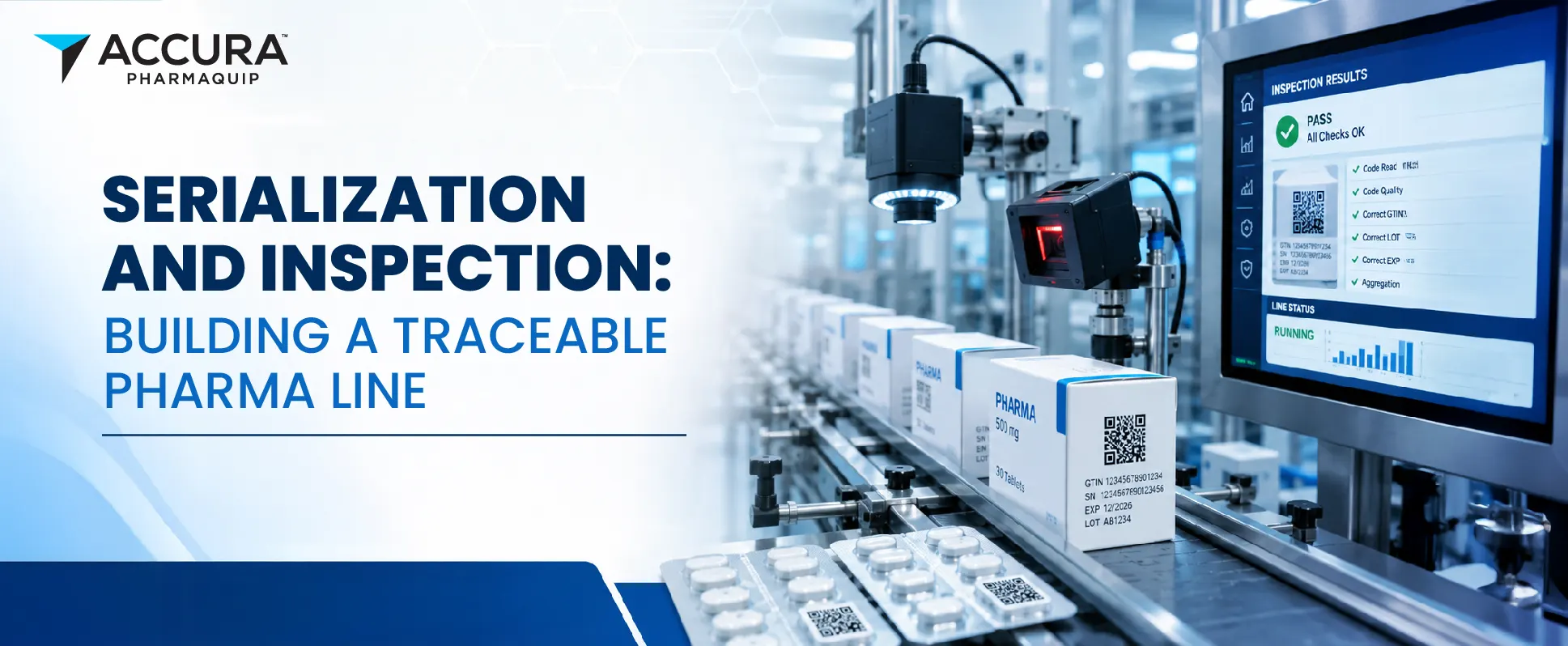
A fully integrated workflow ensures accuracy and compliance throughout packaging operations.
- Step 1: Product enters packaging line.
- Step 2: Unique serial number is generated.
- Step 3: Code is printed on packaging.
- Step 4: Vision inspection system verifies print quality and code accuracy.
- Step 5: Serialization data is uploaded to the database.
- Step 6: Rejected packs are automatically removed.
- Step 7: Verified products proceed to aggregation and distribution.
This process ensures only compliant products move through the supply chain.
Key Inspection Technologies Supporting Serialization
Machine Vision Systems
Used for:
- Barcode verification
- Print inspection
- Label validation
- Packaging checks
OCR/OCV Technology
Used for:
- Text verification
- Batch number validation
- Expiry date verification
- Label accuracy checks
Reject Mechanisms
Ensure:
- Non-compliant products are removed
- Serialization data remains accurate
- Supply chain integrity is maintained
Data Management Software
Supports:
- Real-time reporting
- Audit trails
- Traceability records
- Compliance documentation
Regulatory Requirements Driving Serialization Adoption
Governments across the globe have introduced serialization requirements to improve pharmaceutical supply chain security.
United States
Drug Supply Chain Security Act (DSCSA)
Requires end-to-end pharmaceutical traceability.
European Union
Falsified Medicines Directive (FMD)
Mandates safety features and serialization on prescription medicines.
India
- Export serialization requirements
- Ongoing track-and-trace initiatives
Other Major Markets
- Saudi Arabia
- Brazil
- South Korea
- China
Why Compliance Matters
Failure to comply can result in:
- Product recalls
- Regulatory penalties
- Market access restrictions
- Brand reputation damage
Benefits of Integrating Serialization and Inspection
- Enhanced Product Traceability: More traceability of the product (all steps in manufacturing, packaging, and shipping).
- Improved Patient Safety: Protect against fake, incorrectly labeled, or wrong products from getting into the consumer’s hands.
- Stronger Regulatory Compliance: Maintain an exact record keeping process; ready for audits at all times.
- Reduced Packaging Errors: Identify label and coding mistakes prior to shipping.
- Better Recall Management: Locate affected items immediately and remove them from circulation.
- Increased Consumer Trust: Show a customer you care about quality, safety, and authenticity.
Building a Fully Traceable Pharma Production Line
Creating a connected traceability ecosystem requires multiple integrated layers.
- Level 1 – Packaging Equipment: Product handling and packaging operations.
- Level 2 – Inspection Systems: Verification of coding, labeling, and product quality.
- Level 3 – Line Management Software: Coordinates serialization and inspection processes.
- Level 4 – Site Serialization Management: Manages serialization data across production lines.
- Level 5 – Enterprise Traceability Platform: Provides enterprise-wide visibility and regulatory reporting.
Together, these layers create a comprehensive track-and-trace infrastructure.
Common Challenges in Serialization Projects
Challenge 1: Integration with Existing Equipment
Solution: Modular machine inspecting and serializing machines can be installed on your current manufacturing line.
Challenge 2: Managing Large Volumes of Data
Solution: A centralized platform to store information about products you are producing and report out to management.
Challenge 3: Maintaining High Production Speeds
Solution: High speed computer vision machines that continuously operate to ensure quality and production demands.
Challenge 4: Validation and Compliance
Solution: Validation processes of what is done and documentation methods.
The Future of Traceable Pharmaceutical Manufacturing
Serialization and inspection technologies continue to evolve alongside Pharma 4.0 initiatives.
AI-Powered Vision Inspection
- Smarter defect detection
- Improved code verification
- Reduced false rejects
Cloud-Based Serialization Platforms
- Centralized visibility
- Global access to traceability data
- Simplified compliance reporting
Blockchain for Supply Chain Traceability
- Enhanced transparency
- Improved security
- Stronger product authentication
Predictive Quality Analytics
- Early issue detection
- Proactive quality management
- Reduced operational risks
Industry 4.0 Integration
- Connected manufacturing systems
- Real-time decision-making
- Intelligent production environments
Key Insights
Future pharmaceutical production lines will rely on automation, real-time data, and advanced inspection technologies to achieve complete traceability.
How Accura Pharmaquip Supports Traceable Pharma Manufacturing
Advancing Quality, Compliance, and Traceability
Accura Pharmaquip provides advanced inspection solutions that help pharmaceutical manufacturers strengthen quality assurance and support serialization initiatives.
Our Solutions Include:
- Advanced tablet inspection machines
- Capsule inspection systems
- High-precision vision inspection solutions
- Automated defect detection systems
- GMP-compliant equipment design
- Data integration capabilities
- Support for digital manufacturing initiatives
- Validation and regulatory compliance assistance
Why Choose Accura Pharmaquip?
Our inspection technologies help manufacturers build robust, compliant, and future-ready pharmaceutical production environments while supporting traceability and operational excellence.
Conclusion
Serialization and inspection are no longer separate quality functions. Serialization and inspection form a single system that provides pharmaceutical production lines with traceability, compliance, patient safety and supply chain security.
Investing in Integrated Serialization & Inspection Technologies now will help companies prepare themselves as Regulations Evolve and Patient Safety Remains at the Top of All Lists of Priorities.
Looking to enhance traceability and quality assurance in your pharmaceutical production line? Contact Accura Pharmaquip to learn about our next generation of advanced inspection solutions for the future of pharmaceutical manufacturing.
FAQs
What is the purpose of a capsule elevator in pharmaceutical manufacturing?
An automated capsule elevator can be used to move capsules from one stage of production to the next. It enables better production efficiencies, better cleanliness/hygiene levels as well as it provides consistency of operations.
How does a capsule elevator improve GMP compliance?
Automated capsule elevators assist in reducing employee interaction with equipment, support a “dust-free” environment during transfer operations, and utilize hygienically constructed materials such as stainless steel, which is acceptable for GMP compliant production areas.
Can capsule elevators be integrated with existing production lines?
Most modern capsule elevators have been designed to easily interface with various levels of production including but limited to; capsule filling machines, packaging machinery, and material handling systems.
Are capsule elevators suitable for nutraceutical manufacturing?
Yes. Automated capsule elevators have become a staple in the design of many nutraceutical and healthcare supplement production facilities due to their ability to transfer capsules in a clean/hygiene-controlled manner.
What are the maintenance requirements for capsule elevators?
You should clean all surfaces; inspect components; lubricate moving parts; and perform routine preventive maintenance to make sure your capsule elevator is reliable for the duration of its service life.