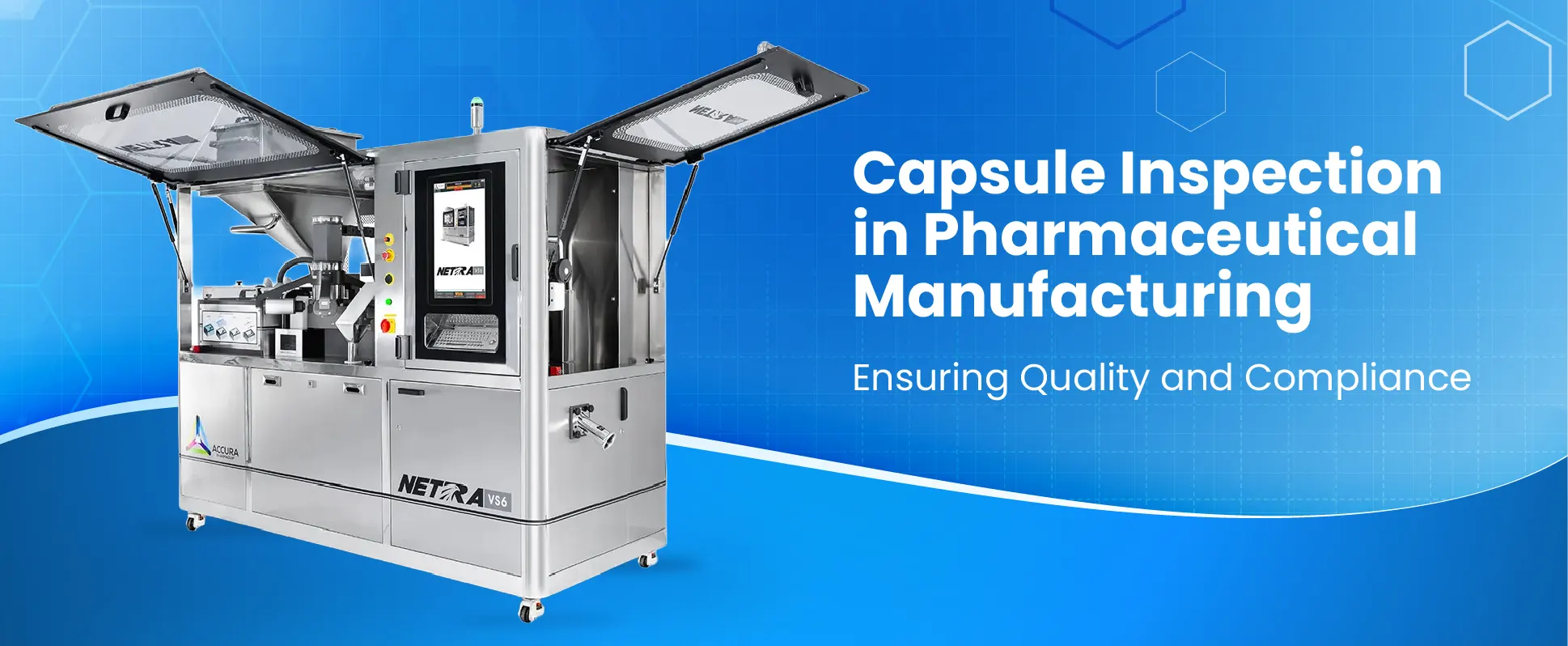
What is Capsule Inspection?
Capsule inspection involves visually inspecting or evaluating the filled capsules against established criteria for quality prior to their placement into packages for distribution.Role in the production lifecycle:
Capsule Inspection is usually performed once all capsules have been filled and sealed, and just prior to packaging. The role of Capsule Inspection is to act as a final checkpoint to remove defective units from the process stream.Key Inspection Parameters:
- Physical integrity – ensures the capsules have no physical damage; they should be intact with a good seal and no crack or split in them.
- Fill consistency – verifies there is an appropriate quantity of active ingredients in all capsules.
- Surface defects – visually identifies any surface imperfections (i.e., denting, dis-coloration, etc.) on capsules due to printing.
- Contaminant detection – identifies and detects the presence of extraneous materials which can pose a threat to user safety.
Importance of Capsule Inspection in Modern Pharma Manufacturing
a. Regulatory Compliance
All pharmaceutical companies must comply with all GMPs and regulations of worldwide regulatory agencies. Capsule inspections are a means for adherence to these requirements to ensure the timely detection of potential capsule defects through tracking and documentation.b. Patient Safety
Capsules containing incorrect fill volumes, i.e., underfilled, overfilled, or improperly sealed, can lead to incorrect administration of medication, which may affect both the efficacy of the therapy being administered to patients and ultimately their health status.c. Brand Reputation
Companies with inconsistent product quality have less consumer trust than companies that produce consistent quality products. Inspection of capsules is essential in ensuring consistency in the production of pharmaceutical products for high-quality standards and credibility in competitive markets.d. Operational Efficiency
Inspecting for defects early on in the manufacturing process will reduce waste and re-work, therefore reducing the cost associated with producing defective products. In addition to increasing efficiency in manufacturing processes, performing inspections will prevent large-scale recalls of defective products.Common Capsule Defects Detected During Inspection
Cracked or Split Capsules:
Cause: Improper handling, poor shell quality, or incorrect machine settings Risk: Leakage of contents and compromised dosageImproper Sealing or Locking:
Cause: Faulty filling equipment or incorrect alignment Risk: Capsule opening during transport or consumptionUnderfilled or Overfilled Capsules:
Cause: Inconsistent filling process or material flow issues Risk: Inaccurate dosing affecting efficacy and safetyColor Variation or Printing Defects:
Cause: Inconsistent coating or printing errors Risk: Brand inconsistency and potential regulatory concernsPresence of Foreign Particles:
Cause: Contamination from environment or machinery Risk: Serious health hazards and compliance violationsManual vs Automated Capsule Inspection
Manual Inspection
Benefits:
- Lower initial investment
- Flexible for small batches
Limitations:
- Operator fatigue leads to errors
- Inconsistent inspection quality
- Slower processing speeds
Automated Inspection
Benefits:
- High-speed inspection suitable for large-scale production
- Accurate and repeatable results
- Reduced human intervention
Technologies Involved:
- Vision systems for defect detection
- Sensors for weight and dimensional checks
Suitability:
Ideal for modern pharmaceutical facilities handling high production volumes and strict compliance requirements.Role of Advanced Technologies in Capsule Inspection
The use of advanced technologies has improved the speed and accuracy of capsule inspection methods.Machine Vision & High-Resolution Imaging:
Machine vision and high-resolution imaging capabilities that are able to detect microscopic defects with great precision.AI-Driven Defect Detection:
Defects can be detected using AI-based technology, which learns from data patterns and will increase the chances of accurate defect detection as well as decrease the number of false rejects.Real-Time Monitoring and Analytics:
The ability to monitor and analyze real-time data allows for greater process control and ultimately will lead to fewer defective products.Integration with Industry 4.0:
A connection through Industry 4.0, or “smart factory,” will allow inspection systems to communicate directly with the digital manufacturing platform, providing enhanced product tracing and manufacturing optimization.How Accura Pharmaquip Enhances Capsule Inspection
The leader in pharmaceutical manufacturing equipment inspections, Accura Pharmaquip offers the most advanced capsule inspection systems available for today’s large-scale production facilities.Key features of their systems include:
- High Reliability & Accuracy: Has been proven to detect capsule defects at extremely high rates.
- Meets All Relevant International Regulations: Meets all current (and future) international standards governing pharmaceutical manufacturing.
- Customized Solutions: Accommodates production of capsules of varying shape and size.
- Easy to Use & Maintain: User-friendly design minimizes both initial operator training and ongoing maintenance costs.
- Easily Integrated into Your Existing Production Line: Designed to work seamlessly with your existing production line.
Value Delivered:
Accura Pharmaquip helps manufacturers improve productivity, maintain compliance, and achieve superior quality assurance with minimal downtime.Best Practices for Effective Capsule Inspection
- Regular Calibration And Validation Of Equipment Used In The Inspection Process: Guarantees that the same level of precision is achieved by the use of inspection devices every time
- SOP Compliance By Trained Personnel Performing The Inspection: Trained operators increase inspection reliability
- Ongoing Observation And Data Recording During The Inspection: Can be used to track trends and find a way to avoid recurring defects
- Maintenance To Prevent Downtime And Equipment Failure: Will minimize both equipment failure and lost time from inspections
Future Trends in Capsule Inspection
- The Increasing Use of Automated Systems and AI Technology in Defect Detection: More advanced technology will allow for better detection of defects as well as less operator involvement during inspections
- Data Analytics-Based Predictive Quality Control: Use of data analytics will enable manufacturers to detect potential defects before they happen
- Use of Digital Technologies to Integrate With Production Ecosystems (i.e. smart factories): Capsule inspection technologies will begin to integrate into smart factory environments
Conclusion
Capsule inspection is an important element of the pharmaceutical manufacturing process; it enables drug manufacturers to ensure their products are safe, of good quality and comply with regulations. In light of ongoing changes within the pharmaceutical sector, using old-fashioned or manual methods of inspection will be inadequate going forward. Modern inspection solutions are necessary to address these changing requirements, and that is where Accura Pharmaquip fits into this picture. The company provides customers with both compliant and custom-designed inspection systems designed to provide the highest level of precision. We at Accura Pharmaquip can help you upgrade your capsule inspection system. Please contact Accura Pharmaquip today to receive information about developing customized, high-performance inspection solutions for your specific production needs.FAQs
What is capsule inspection?
Capsule inspection entails a review of filled capsules as part of ensuring these meet the requirements for Quality, Safety and Compliance prior to being packaged.
Why is capsule inspection important?
Ensuring correct dosing, preventing products with faults/defects from being sold to consumers, and complying with regulations by monitoring products throughout their development stages.
What defects are commonly detected?
Common types of defects found when inspecting include cracks, improper seals (closures), inconsistent fills, varying colors, and contaminants.
Manual vs automated inspection, which is better?
Automated is generally preferred when dealing with large quantities. However, a manual may be used for smaller-scale operations.
How does Accura Pharmaquip help?
Accura Pharmaquip offers highly customized inspection systems capable of improving operational efficiency, supporting regulatory compliance, and maintaining quality production standards within capsule manufacturing.