With the increasing automation of pharmaceutical manufacture, it is important that quality control matches this process. An important consideration for manufacturers of tablet inspection equipment is whether to perform this inspection inline or offline.
Consistent tablet and capsule inspection is essential for pharmaceutical manufacturers to ensure quality control and detect defects. Although manual inspection becomes increasingly challenging with increased speeds of manufacture, vision inspection can offer automated rejection of products.
The question then becomes not simply “Should we automate?”, but “Where should the inspection take place?”.
Understanding Inline Tablet Inspection
Inline tablet inspection is integrated directly into the production workflow. Tablets or capsules are inspected as they move through the manufacturing process, allowing manufacturers to identify and reject defective products without creating a separate inspection stage.
How Inline Inspection Works
A typical inline inspection process follows:
Tablet Production → Tablet Flow → Vision Inspection → Defect Detection → Automatic Rejection → Accepted Tablets
The process involves:
- 1. products enter the inspection system as part of the production flow.
- 2. Cameras and sensors capture images from relevant viewing angles.
- 3. Image-processing software evaluates the products against predefined defect parameters.
- 4. Defective products are identified and automatically separated.
- 5. Accepted tablets continue towards the next stage of production.
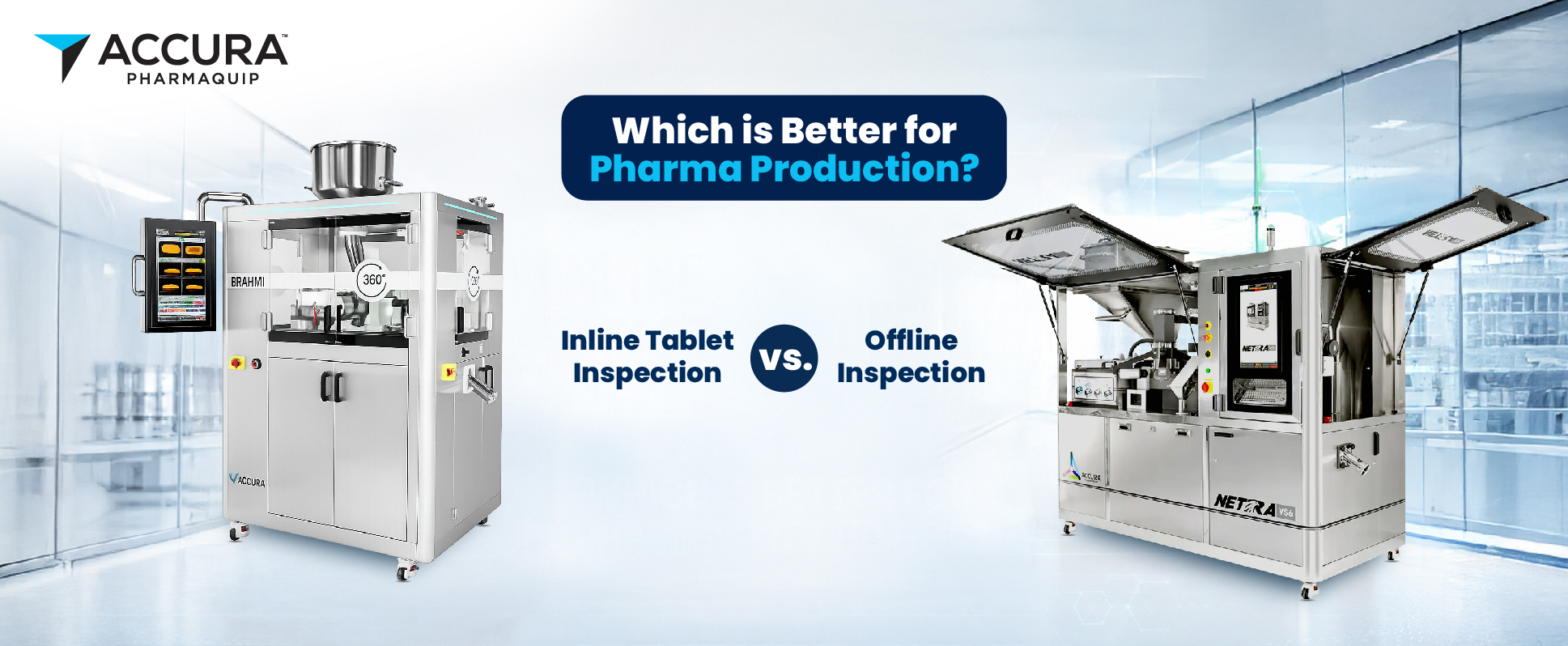
For example, Accura’s Netra VS6 uses multiple cameras to inspect tablets from different angles and automatically reject products that fail the defined inspection criteria.
Key Advantages of Inline Inspection
Inline inspection can offer:
- Continuous inspection
- High throughput
- Automated defect rejection
- Reduced manual handling
- Faster feedback to production
- Better integration with the production line
- Consistent inspection criteria
- Inspection data and reporting
For high-volume manufacturing, this allows quality inspection to become part of the production process rather than a separate activity.
Understanding Offline Tablet Inspection
Offline inspection takes place separately from the main production process. Products are collected or sampled and transferred to a dedicated inspection system, laboratory or quality-control environment.
A typical workflow is:
Production → Collection → Sampling/Transfer → Offline Inspection → Sorting/Analysis → Further Action
When Is Offline Inspection Used?
Offline inspection can be useful for:
- Laboratory or quality-control evaluation
- Sampling-based inspection
- Smaller production volumes
- Product development
- Process troubleshooting
- Targeted quality investigations
- Situations where inline integration is not practical
Advantages of Offline Inspection
Offline inspection can be easier to deploy in certain facilities and can work well for laboratory and QC environments. It can also be suitable for smaller batches or applications where continuous 100% inspection is not required.
This makes offline inspection an important part of the quality-control toolkit rather than simply an alternative to inline inspection.
Inline vs. Offline Inspection - At a Glance
| Parameter | HPMC Capsules | Gelatin Capsules |
|---|---|---|
| Inspection location | Production line | Separate inspection area |
| Inspection approach | Continuous | Batch/sample based |
| Production integration | High | Low |
| Automation potential | High | Moderate–High |
| Manual handling | Lower | Higher |
| Real-time defect detection | Yes | Limited |
| Automatic rejection | Yes | Depends on system |
| High-speed production | Excellent fit | Less suitable |
| Process feedback | Immediate | Delayed |
| Best suited for | High-volume production | Sampling, QC, special applications |
Neither approach is universally superior. The right choice depends on production volume, quality strategy, integration requirements and inspection objectives.
Which Inspection Method Provides Better Quality Control?
Inline inspection continuously evaluates products during manufacturing. Defects can therefore be identified while production is underway, helping prevent defective products from progressing downstream and reducing dependence on manual sorting.
Offline inspection, meanwhile, provides a more controlled environment for targeted inspection, sampling and investigation. It may be appropriate when continuous inline inspection is not required.
For high-volume pharmaceutical production where the objective is continuous, automated inspection, inline systems generally offer a stronger operational advantage.
Inline Inspection for High-Speed Pharmaceutical Production
Production speed is an important consideration when selecting a tablet inspection machine. If inspection cannot keep pace with manufacturing, it can become a bottleneck.
Inline inspection addresses this by integrating quality inspection into the continuous product flow.
Key benefits include:
- High production speed: Inspection can operate alongside high-speed manufacturing.
- Continuous product flow: Products do not need to be diverted for a separate inspection stage.
- Reduced bottlenecks: Automated inspection can minimise delays associated with manual sorting.
- Less handling: Products can remain within the production workflow.
- Faster rejection: Defective units can be automatically separated during production.
As a contextual example, Accura’s Q1 Premium is specified for up to 100,000 products per hour, while BRAHMI is specified for up to 150,000 pills per hour, depending on product size and customisation.
What Tablet Defects Can Automated Inspection Detect?
Automated machine vision can evaluate tablets and capsules against predefined inspection parameters.
Common Tablet Defects
Depending on the system configuration, inspection can identify:
- Cracks
- Capping
- Chipping
- Broken tablets
- Discolouration
- Discolouration
- Spots
- Surface imperfections
- Shape abnormalities
- Foreign particles
Common Capsule Defects
Automated inspection can also identify:
- Damaged capsules
- Deformed capsules
- Empty capsules
- Improperly joined cap and body
- Colour variations
- Surface defects
Machine vision helps standardise inspection criteria by applying predefined parameters consistently across products.
Accura’s inspection systems are designed for tablet and capsule applications, with BRAHMI supporting hard and soft gelatin products and 360° inspection.
Why Are Pharma Manufacturers Moving Toward Automated Inspection?
Manual inspection is human-dependent and can become challenging as production speeds increase. Fatigue and variations in visual assessment can also make it difficult to maintain consistent inspection over long production runs.
Automated inspection, by comparison, can provide:
- Consistent inspection parameters
- High-speed operation
- Automated rejection
- Digital reporting
- Reduced manual intervention
This does not eliminate the role of quality personnel. Instead, automation can handle repetitive, high-speed visual inspection while allowing teams to focus on quality oversight, investigation and process improvement.
Accura’s Netra VS6 specifically incorporates automated inspection, defect sorting and reporting capabilities.
The Role of Data in Modern Tablet Inspection
Modern inspection is increasingly about more than identifying defective products. The data generated during inspection can support quality monitoring, investigation and traceability.
Depending on the system, this may include:
- Batch records
- Inspection parameters
- Rejection records
- Alarm records
- Audit trails
- Production trends
- Electronic data records
Accura’s Netra VS6 documentation describes inspection reports, audit trails, alarm reports, parameter-setting records and batch-trend reporting.
Such data can support quality investigations, process monitoring, documentation, traceability and continuous improvement.
However, an inspection system is one component of a broader pharmaceutical quality system. Appropriate validation, procedures and documentation remain essential.
Is Inline Inspection More Expensive?
Comparing inline and offline inspection purely on purchase price can be misleading. A more useful approach is to consider Total Cost of Ownership (TCO).
This can include:
Initial Investment + Integration + Labour + Maintenance + Downtime + Product Losses + Quality-Related Costs
An inline system may require greater initial investment and production-line integration. However, its value can come from continuous inspection, automation, reduced product handling and improved production efficiency.
Offline inspection may be more appropriate when production volumes are lower or inspection is primarily sampling-based.
The question is therefore not simply “Which system costs less?” but “Which inspection approach delivers the right quality and operational value for the production process?”
Inline or Offline Inspection: Which Should You Choose?
Choose Inline Inspection When:
- Production volumes are high.
- Continuous inspection is required.
- Automated rejection is important.
- Alarm recordsInspection needs to be integrated with production.
- Manual inspection is creating bottlenecks.
- Immediate defect detection is important.
Consider Offline Inspection When
- Production volumes are relatively low.
- Inspection is primarily sampling-based.
- The system is intended for laboratory or QC purposes.
- Inline integration is not practical.
- Inspection is required for development or troubleshooting.
For some manufacturers, the most effective strategy may involve both approaches—using inline inspection for continuous production control and offline inspection for targeted investigations, sampling and development.
Automated Tablet & Capsule Inspection by Accura Pharmaquip
Accura Pharmaquip provides automated inspection solutions for pharmaceutical manufacturing, with capabilities including:
- Automated vision inspection
- Tablet and capsule inspection
- High-speed inspection
- 360° product inspection
- Automated defect rejection
- Inspection reporting
- GMP-oriented machine construction
- Product flexibility
Accura reports more than 480 installations across its company history and supplies tablet and capsule inspection systems globally.
BRAHMI
BRAHMI is an automated inspection platform for tablets, capsules and softgels. It features six high-resolution industrial vision cameras and independent image-processing controllers.
Its published capacity is up to 150,000 pills per hour, depending on product size and customisation.
Q1 Premium
Q1 Premium is designed for tablet and capsule inspection and uses 360° product rotation to support inspection from multiple views. Its published inspection capacity is up to 100,000 products per hour.
The appropriate system ultimately depends on the product, production speed, inspection parameters and integration requirements.
Inline Inspection Is the Future of High-Speed Pharmaceutical Quality Control
Offline inspection continues to have an important role in sampling, laboratory evaluation, product development and specialised quality-control applications.
However, for high-volume pharmaceutical manufacturing where continuous inspection, automated rejection and production-line integration are priorities, inline inspection offers significant operational advantages.
It can help manufacturers identify defects during production, reduce manual handling and maintain consistent inspection standards while keeping pace with modern production speeds.
The decision between inline and offline inspection should ultimately be based on the manufacturer’s production environment, quality objectives and inspection strategy.
With automated tablet and capsule inspection solutions designed for high-speed pharmaceutical production, Accura Pharmaquip helps manufacturers move towards more consistent, automated and data-driven quality inspection.
FAQs
What is inline tablet inspection?
Inline tablet inspection is an automated inspection process integrated into a pharmaceutical production line. Products are inspected as they move through production, allowing defects to be detected and rejected automatically.
What is offline tablet inspection?
Offline tablet inspection takes place separately from the production line. Products are collected or sampled and transferred to a dedicated inspection or QC environment.
Is inline tablet inspection better than offline inspection?
Not universally. Inline inspection is generally better suited to high-volume production requiring continuous automated inspection, while offline inspection can be useful for sampling, QC, development and troubleshooting.
Can inline inspection detect tablet defects automatically?
Yes. Automated vision inspection systems can be configured to detect predefined defects and automatically reject products that fail the inspection criteria.
Can the same inspection machine inspect tablets and capsules?
Certain pharmaceutical inspection systems are designed for both tablets and capsules. Capabilities depend on the machine configuration and product characteristics.
What defects can a tablet inspection machine detect?
Depending on the system, defects can include cracks, capping, chipping, broken tablets, discolouration, spots, surface imperfections and shape abnormalities.
Is automated tablet inspection suitable for high-speed production?
Yes. Automated inspection is particularly suited to high-speed production because it can continuously inspect products and automate defect rejection.
How does machine vision improve tablet inspection?
Machine vision captures product images and evaluates them against predefined parameters, helping provide consistent inspection criteria and reduce dependence on manual visual inspection.
What should pharma manufacturers consider before buying an inspection machine?
Manufacturers should consider production speed, product type, defect requirements, inspection coverage, integration, rejection mechanisms, reporting, validation requirements, maintenance and total cost of ownership.
How much does a tablet inspection machine cost?
Cost varies based on factors such as machine configuration, production speed, inspection requirements, automation level and integration. Total cost of ownership should be considered alongside the initial investment.